ID
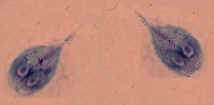
The following image is from the stool of a 35 year old gentleman who continues to lose
weight inspite of a high calorie diet.
Which of the following statements is true regarding his condition:
The answer is choice B. This is the beautiful looking Giardia lamblia. It is in the trophozoite stage. They are notorious for malabsorption which would be the cause of this man's weight loss. HIV infection predisposes to all sorts of GI pathogens but is certainly not the commonest accompaniment of Giardia. Giardia is rampant in general population without any predisposing conditions. Its spread is Feco-oral and treatment is Metronidazole (Flagyl). Metronidazole is an Aldehyde dehydrogenase blocker therefore causes serious side effects if a patient drinks alcohol while taking it.
With Giardiasis, vomiting is not a prominent feature but there is an interesting reflex that gets enhanced : Gastrocolic reflex - whenever a patient eats, his colon is stimulated too and the person has to go have a bowel movement.
As per the osmolality, the BMs are not high osmolality BMs. In infective diarrheas, BM is of either the same osmolality as serum or less. In Osmotic diarrheas - which are due to high osmolality feeds, the stool is hyperosmolar. Treatment for osmotic diarrheas is dilution of the diet.
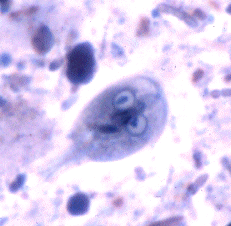 Trophozoite stage |
To make a diagnosis, the trophozoite stage and WBCs must be seen in
the feces. Trophozoite stage alone does not constitute the diagnostic criteria by itself
since some patients may just shed the parasite without any disease. Diagnosis can now be made using Serology (ELISA) or may be made using the string test from the mouth allowing one end of a thread to go down into the duodenum and pulling back for microscopy. |