Quiz week 28
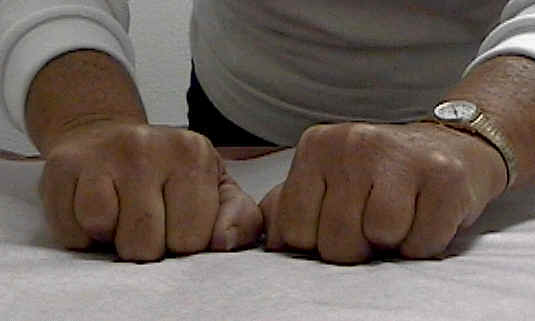
A 35 year old lady comes to your clinic with the chief complaint of headaches. They mainly bother her during the daytime and are associated with nausea. She also complains of seeing flashing lights. She had one episode about 2 days ago when her vision blacked out for about 15 minutes. It started in the corner of her right visual field and progressed over her complete visual field. You label the episode as complicated migraine and go on to examine her. There are no significant findings except what is shown in the picture below.
You get an Xray of her hands which is shown below.

Q1. All of the following are compatible findings with her possible diagnoses EXCEPT?
The answer is choice 5.(Nail fungus infection). From your answers, it seemed that almost everyone knew that this is a case of pseudohypoparathyroidism (or pseudo-pseudohypoparathyroidism). The 4th metacarpal is short. This is one of my patients but I cannot take credit for the diagnosis as that had already been made before I met her.
What only one doctor - who attempted the quiz (from Turkey) knew is that this is also found in Turner's syndrome - and thus associated with high LH/FSH levels. There is an endocrinopathy where there is hypoparathyroidism and nail fungus (mucocutaneous candidiasis) but it is not pseudohypoparathyroidism.
In recent years we have found that the problem with pseudohypoparathyroidism (PHP) lies at the molecular level with an abnormal G - protein. Mental impairment can be a feature of both - PHP and Turners. The level of calcium is low and phosphate is high but the PTH level is normal or elevated. The response of c-AMP in urine upon giving IV PTH is low in these patients (normal response is a marked increase in c-AMP excretion
In pseudopseudohypoparathyroidism, patients have the morphologic features of PHP but the chemistries are all normal.
Q2. In your workup of the patient, you find that the patient has decreased serum calcium level. She also has a decreased urinary response to IV PTH. What should be done to treat the patient?
The answer is choice 1. Calcium and vitamin D are the treatments of choice for PHP. nasal Calcitonin is now used in prevention of osteoporosis but its most important use is control of pain in bone metastases and myeloma. Other choices are meaningless.