Quiz week 31
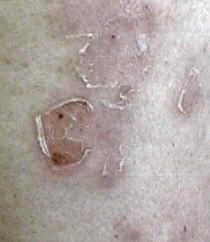
This patient came to you complaining about this peeling off of her skin. She describes that a blister appears and then bursts.
Q1. Which of the following is FALSE about the patient
The answer is choice 1. Of course everyone knew that this is pemphigus. It is of 3 types and one of them is paraneoplastic type that is particularly associated with thymoma and myasthenia. Treatment is steroids and the antibody is deposited between the cells in the epidermis (not the dermo-epidermal junction - which is a feature of pemphigoid).
Q2. There is another patient who has much more tense blisters. They are firm and do not burst easily. Which of the following is FALSE about this patient?
The answer is choice 3. Pemphigoid antibody is deposited deeper (dermo-epidermal junction) therefore the blisters have a thicker covering and can remain tense. They also have a lower chance of bursting (unlike the blisters of pemphigus) thus desquamation and superinfection are less likely. This makes the prognosis better in pemphigoid. Because of the antibody, immunologic studies aid in the diagnosis.