Quiz week 6
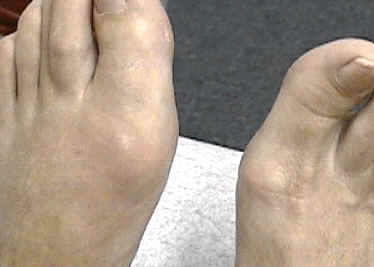
A 55 year old lady presented to your clinic. She complains of severe pain in her left big toe area. She says she cannot even place a sheet on her foot. This is the first time that this has happened. She is sexually active. On examination she has a temperature of 99.9°F. Her big toe is swollen and looks like it is in the photograph below.
Q1. Which of the following is INCORRECT about this patient.
She has a higher likelihood than average to have hypertension.
Her relative risk for hyperlipidemia is more than 1.
Her blood test for this condition at this stage will be lower than her usual.
She may have got this due to diuretics.
Joint aspirate that consists of negatively birefringent crystals
confirms the diagnosis.
The answer is joint aspirate that consists of negatively
birefringent crystals confirms the diagnosis. Read below to see why this is false.
Q2. Which of the following statements about the treatment of this condition is FALSE ?
First line treatment is Indomethacin.
In a patient with GI bleeding, this should be treated using local therapy.
Furosemide reduces the levels of the substance causing this.
A treatment used for this condition is the treatment of choice for familial mediterranean fever.
One of the drugs used to prevent this condition can worsen this problem
now.
The answer is Furosemide reduces the levels of the substance
causing this. No diuretic reduces urate. Furosemide reduces Calcium whereas thiazides
increase calcium so some doctors mistook this choice to be true and chose other choices.
THIS is REAL important stuff.
Gout presents in 50 % of cases as Podagra (big toe - 1st MTP joint
inflammation). Patients get exquisite pain, swelling and redness. They
can have so much sensitivity of the skin that even blowing air on the area can be painful.
Typically, they will complain about the bed-clothes being uncomfortable. Most people will
complain about waking up to see their joint swollen. I wonder if it is the cooler
temperatures of the night that precipitates it or the prolonged time without fluid intake.
Gout is due to uric acid crystals (which are negatively birefringent as opposed to positively birefringent crystals of calcium pyrophosphate in pseudo-gout) but the mere presence of the crystals in synovial fluid does not confirm the diagnosis of acute gout. Gout is the interaction of the crystals with the leukocytes and ONLY if INTRACELLULAR crystals are seen in leukocytes, can one CONFIRM gout. (I have seen this fact being tested in exams).
Provoking stimuli for gout are typically those that reduce serum levels of uric acid. This causes mobilization of urate in the synovium to equilibrate with serum. Mobilization triggers off WBCs sand thus the attack. The serum levels are thus most likely going to be lower than usual. Although mobilization is theoretically possible with events raising urate, this is rarely the case(Thiazide related).
Indomethacin is a great time tested therapy and still stands as first line when diagnosis is clear. Colchicine is second choice (except in situations where the diagnosis is not clear) and as asked in Q2, it is the drug of choice for familial mediterranean fever (fever and massive splenomegaly seen in the mediterranean). Steroids come as third line therapy and in monoarticular flares - should be used as local therapy but in poly-articular presentations(~50%) they should be given systemically. Steroids are helpful in patients with bleeding/ulcer problems and local therapy is preferred over systemic.
Prevention can be achieved using different strategies
but EVERY patient must first be advised about dietary modification (even
though we know that it is hardly effective).
We must first find out who has high serum levels and who has low excretion rates
in urine (24 hour collection). This should not be done in the acute phase as the uric acid
has recently precipitated and the serum levels found would be falsely low( in as many as
40% of patients). After about 6 weeks, one should check levels and give treatment if
necessary. Those who have high serum levels should get Allopurinol. This
is a xanthine oxidase inhibitor. This enzyme is responsible for the
production of uric acid from purines. Agents that enhance Uric acid
excretion are called uricosuric agents and these are useful in patients
who undersecrete in urine. The most important uricosuric agent is Probenecid
(others are Sulfinpyrazone, Steroids, HIGH dose aspirin >2gm/day etc). Low dose
Colchicine too is used in prevention.
Asymptomatic hyperuricemia is not to be treated except in one situation -
just before chemotherapy for a patient with a tumor that will cause levels to sky-rocket.